
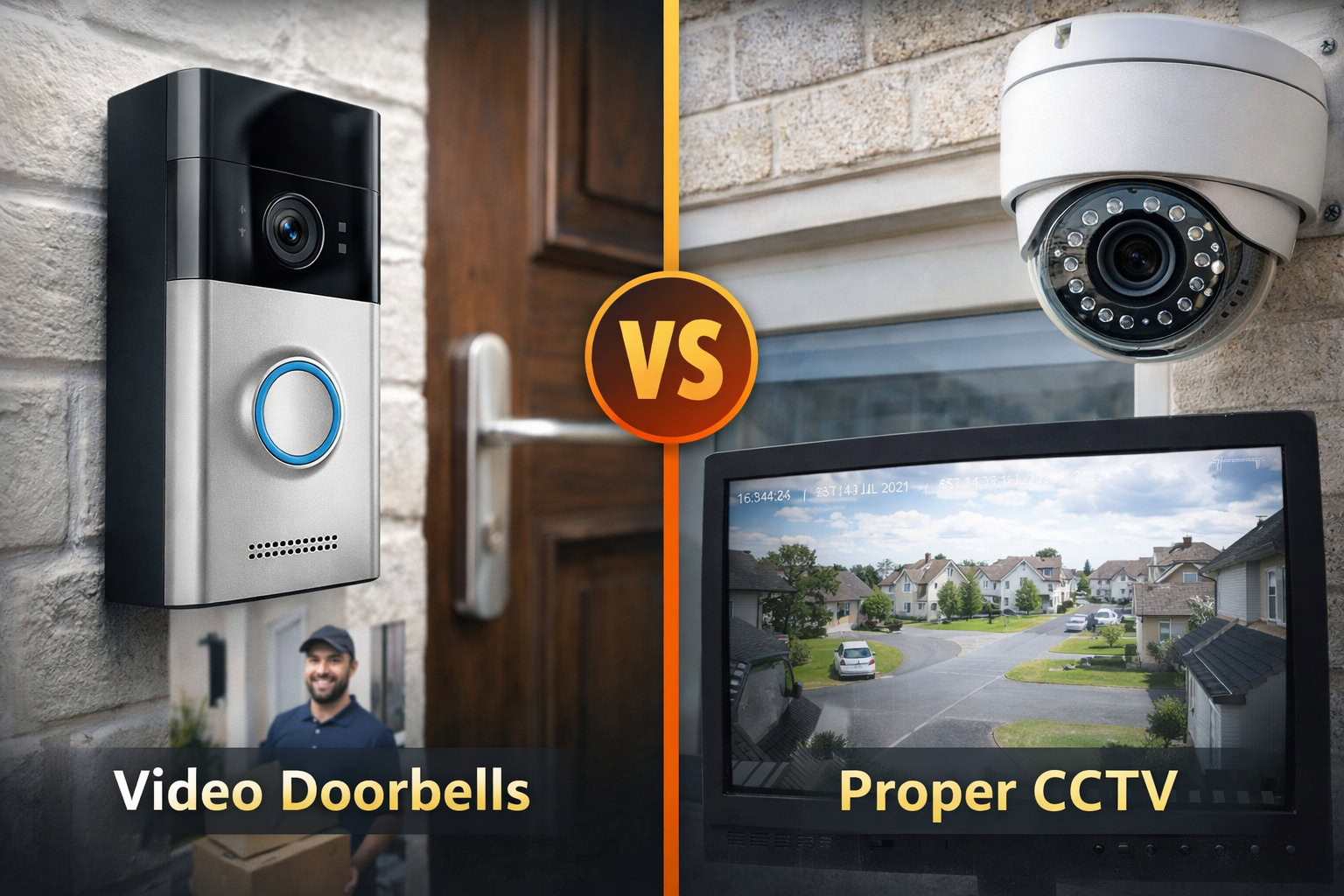
Video doorbells are popular for a reason: they are convenient, affordable and give you quick visibility at the front door. But they are not the same thing as a properly designed CCTV system. If you want reliable coverage around the whole property, the differences matter.
Here is a clear comparison to help you choose the right approach for your home or small business.
What a video doorbell does really well
**1) Visitor management**
Doorbells excel at showing who is at the door and letting you speak to them. For deliveries and unexpected callers, that is a genuine quality of life upgrade.
**2) Front door events and notifications**
Most doorbells are tuned for short, frequent events. The app experience is usually strong, with quick clips and easy playback.
**3) Simple installation**
Many can be installed with minimal cabling. Some use existing doorbell wiring; others are battery powered.
Where doorbells fall short
**1) Limited coverage**
A doorbell is focused on the porch area. It rarely covers side access, driveways, rear gardens or outbuildings. If someone approaches from the side, or the incident happens off the doorstep, you may capture nothing useful.
**2) Inconsistent recording during busy moments**
Doorbells often rely on cloud services and WiFi. If your WiFi drops, or if multiple devices are streaming, you can lose events or reduce quality.
**3) Night performance**
Some doorbells do well at night, but many struggle with wide dynamic range when porch lights or headlights hit the lens. Faces can become silhouettes.
**4) Subscriptions and retention**
Many doorbells require a monthly subscription for longer retention or advanced features. Over time, the total cost can exceed a basic CCTV setup.
What proper CCTV does really well
**1) Full property coverage**
CCTV is designed to cover routes and zones, not just a single door. You can cover:
- Driveway and vehicle areas.
- Side access paths.
- Rear doors and patio.
- Gates, garages and sheds.
**2) Evidence quality and continuous recording**
A good CCTV recorder gives you reliable footage, often with continuous recording where required. That matters for incidents that unfold over several minutes or where you need context before and after the event.
**3) System stability**
Professional CCTV systems do not depend entirely on cloud services. They typically record locally, so even if your internet fails, footage continues to be stored.
**4) Better integration options**
CCTV can integrate with:
- Intruder alarms for event tagging and alerts.
- Lighting for improved night clarity.
- Access control for business sites.
Where CCTV can fall short
CCTV is more involved to design. Poor placement, excessive height, or bad lighting can still produce poor results. It also requires a recorder, storage planning, and tidy cable routes if wired.
Choosing the right setup
Choose **video doorbell only** if:
- Your priority is seeing visitors and managing deliveries.
- You are mainly concerned about front door events.
- You are happy with cloud retention and WiFi dependency.
Choose **CCTV** if:
- You want coverage beyond the front door.
- You need reliable evidence quality, including at night.
- You want local recording and longer retention.
Choose **both** if:
- You want the convenience of a doorbell plus the coverage of CCTV.
- You want a second angle at the front for clearer identification.
A practical approach that avoids overspending
A common, cost effective setup is:
- One doorbell for visitor interaction.
- Two to four CCTV cameras covering driveway, side access and rear doors.
- PIR lighting to support night clarity, positioned to avoid glare.
Harpenden Alarms can advise on the right mix for your property in Hertfordshire, Bedfordshire or Buckinghamshire, ensuring you end up with footage that is actually useful and a system you will keep using.